
Walkthrough
A focused, six-step tour through the full pipeline. Each step shows the code or output exactly as you would see it on a fresh project. The screenshots are generated from real, runnable inputs under tools/screenshots/snippets/ and regenerate via npm run screenshots:cli.
If you have already installed the package and want to see the equivalent terminal session, run the bundled standalone example:
php examples/standalone/generate.phpIt writes a sample invoice to examples/standalone/out/Demo-Invoice-001.xml and reports validator pass/fail. The same pipeline is what the framework adapters wrap.
Step 1: Install
composer require vinelabs-de/xrechnung-kitOptional bundles (only when the corresponding feature is needed):
# KoSIT Schematron validation. Adds the official validator JAR plus
# scenarios. Requires Java 17+ at validation time.
composer require --dev vineethkrishnan/xrechnung-kit-kosit-bundle

# Framework adapter for Laravel.
composer require vineethkrishnan/xrechnung-kit-laravel
vinelabs-de/xrechnung-kit has zero hard runtime dependencies beyond ext-dom, ext-libxml, and ext-mbstring. PSR-3 logging is opt-in.
Step 2: Build a typed MappingData
The entire public input contract is a single value object: XrechnungKit\Mapping\MappingData. Five named constructors map to the five supported document classes. Each constructor is total: required fields are constructor parameters, optional fields are nullable.
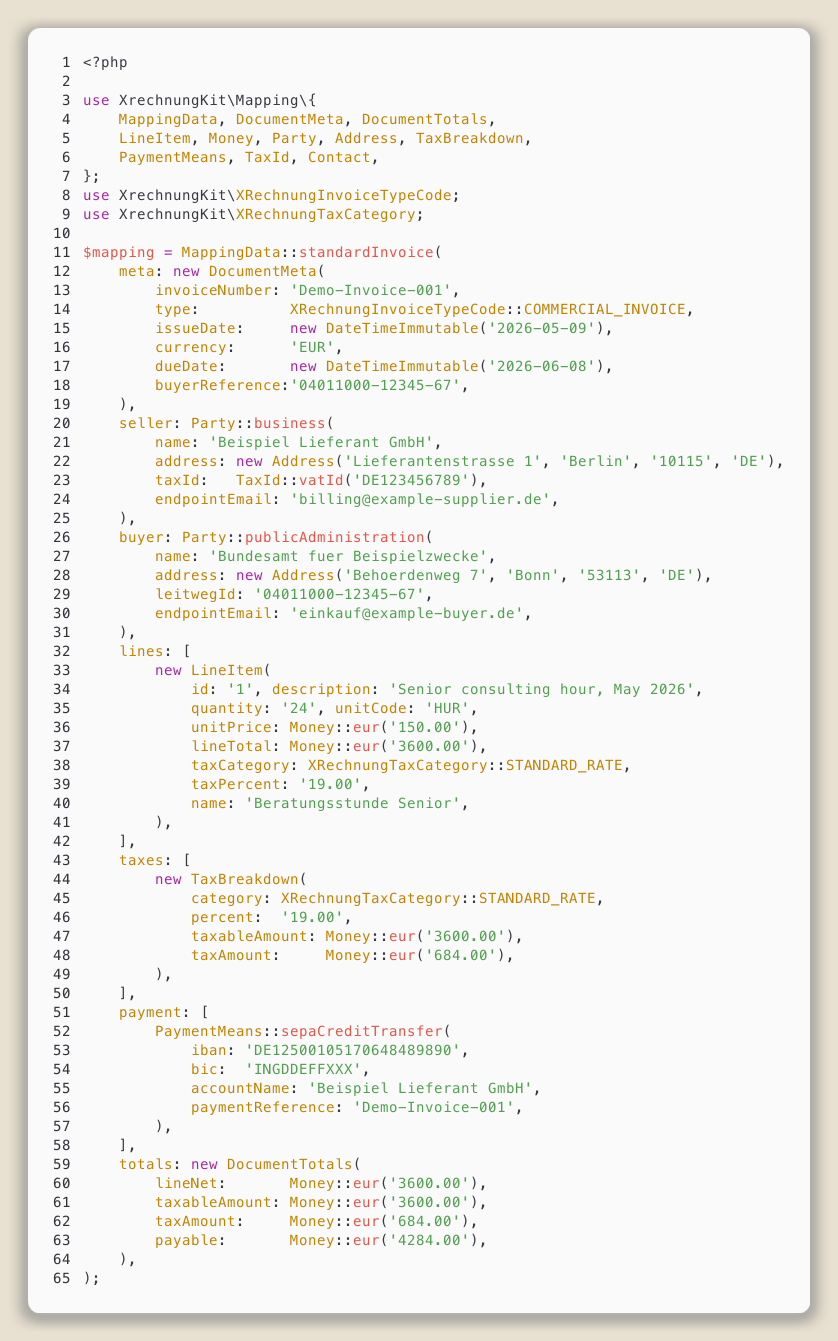
The value objects validate structurally at construction time. If you forget the seller's tax-id or pass a non-EUR currency to a Money::eur factory, you get a \InvalidArgumentException at the point of construction, not deep inside XML generation.
See Mapping data contract for the full surface.
Step 3: Generate
The generator is a thin orchestrator over the lifted L3 pipeline: XRechnungBuilder produces a typed XRechnungEntity, XRechnungGenerator substitutes it into the bundled UBL template, runs UBL XSD validation in memory, and writes atomically to the target path.
php examples/standalone/generate.php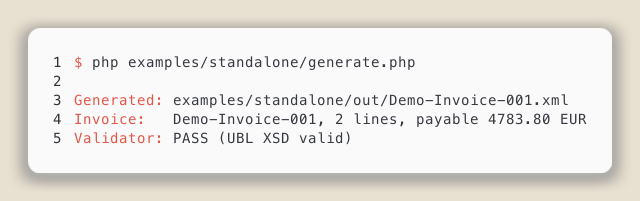
The output file is exactly the path you asked for. No suffix games on the success path.
Step 4: Inspect the output
The generated file is XRechnung 3.0 / EN 16931 conformant UBL Invoice. The first lines carry the standard envelope and identifiers KoSIT looks for:
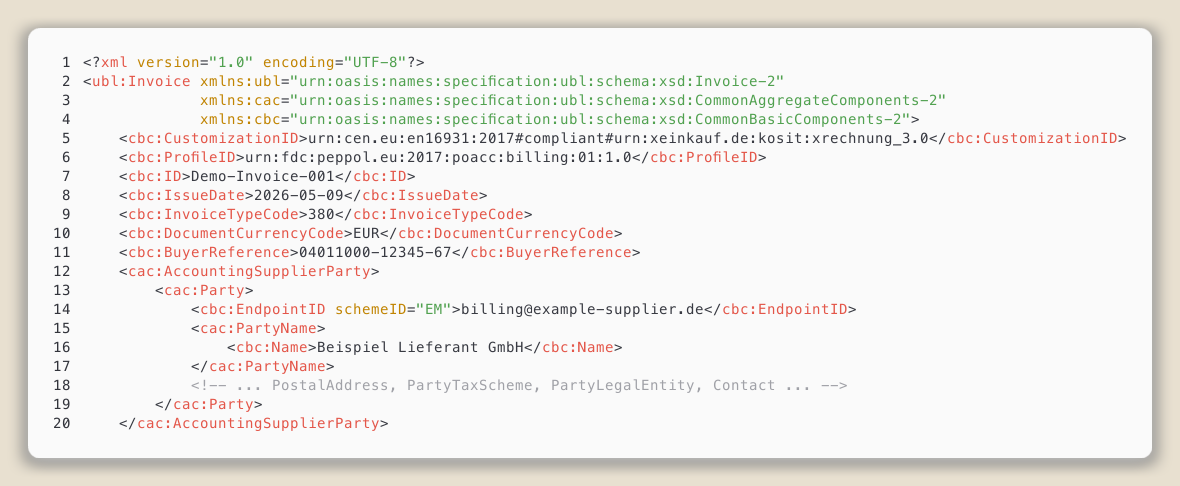
The CustomizationID urn:cen.eu:en16931:2017#compliant#urn:xeinkauf.de:kosit:xrechnung_3.0 is the marker every KoSIT validator looks for. The ProfileID is set to the PEPPOL BIS Billing 3.0 profile. Output is byte-stable within a patch release.
Step 5: Validate
UBL XSD validation has already happened in memory before the file landed on disk. The standalone validator gives you a defensive second pass, plus an optional KoSIT Schematron pass when the bundle is installed.
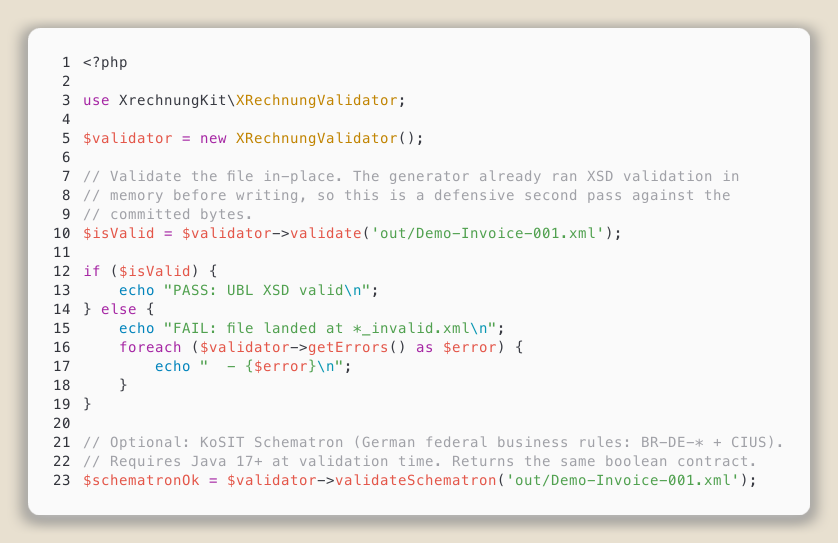
If XSD validation fails at write time, the file is written to a *_invalid.xml sibling instead of the requested path. The opposite-sibling file (if any) is removed atomically, so you cannot end up with both a valid and an invalid version of the same invoice number.
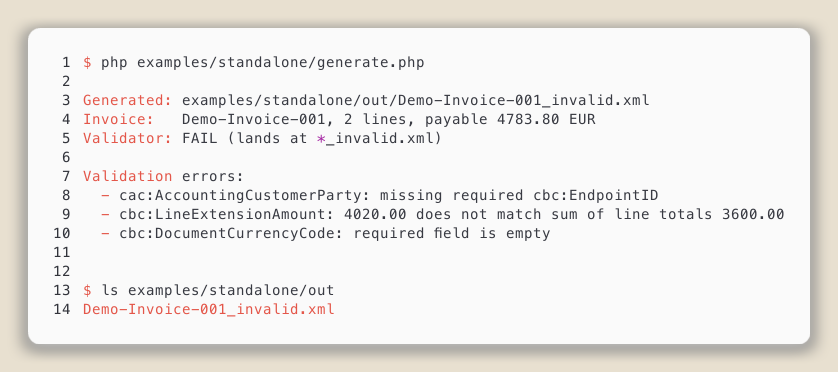
A deduplicated alert is emitted through your configured PSR-3 logger. Repeat invalid generations of the same invoice within a configurable window collapse into a single alert so you do not flood ops on a stuck consumer.
Step 6: Wire it into your stack
In a PSR-only stack, hand-build the validator and generator as shown above. In a framework, install the matching adapter and let it register everything in the container, log stack, and queue.
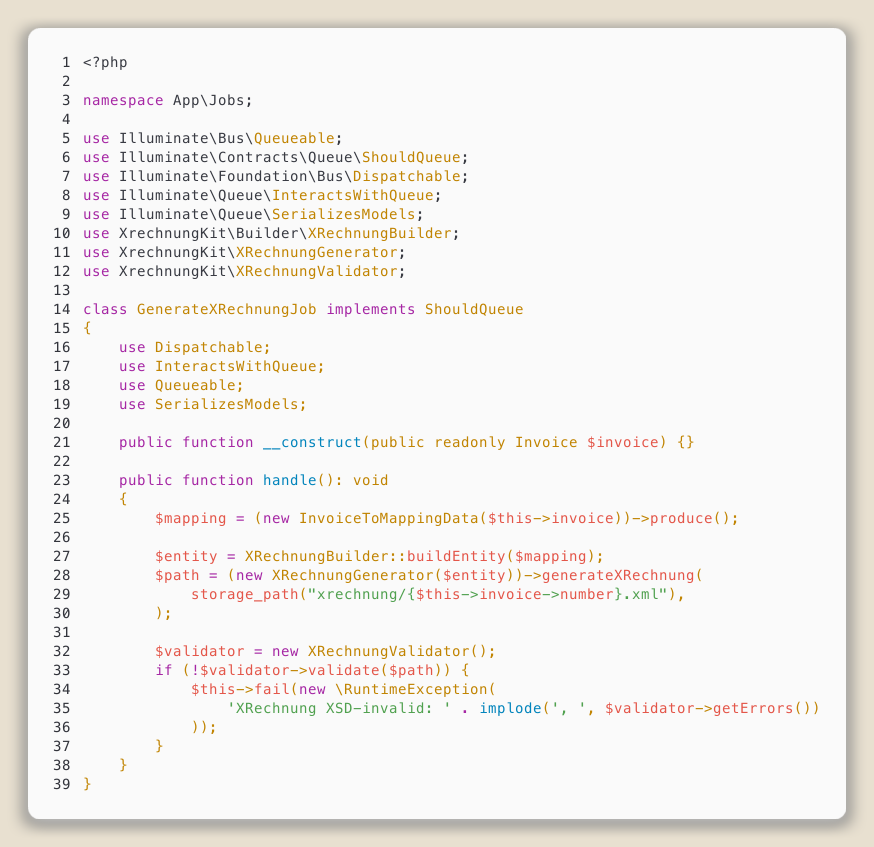
Adapter setup details for each framework:
- Laravel - service provider, facade, queueable job
- Symfony - bundle and DI extension
- CakePHP - plugin and service
- Laminas - module and service factory
What you have at the end
After running the standalone example or the equivalent flow in your own app, you have:
- A KoSIT-strict valid XRechnung 3.0 XML at the path you asked for.
- A guarantee that no invalid XML was ever written to that path. If validation failed, the path holds nothing and the broken bytes are at
*_invalid.xmlfor inspection. - A PSR-3 alert at most once per invoice number per cool-down window when invalid output is generated.
- Zero network calls. Zero telemetry. Zero global state mutated.
Continue with Mapping data contract for the full input shape, API overview for the curated public surface (or the per-class generated reference), or KoSIT Schematron validation for the optional federal-business-rule pass.